
Tombstone
BackDescription:
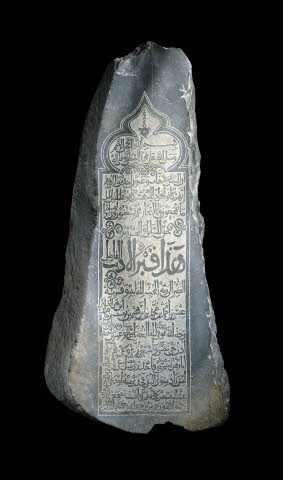
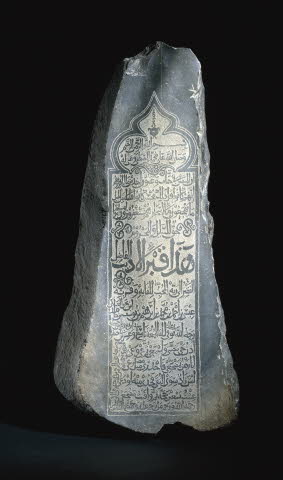
Tombstone carved from basalt with an Arabic inscription.
Object type: | tombstone |
Museum number: | 1928,0305.1 |
Culture/period: | Islamic |
Findspot: | Found/Acquired: Dahlak Kebir |
Materials: | basalt |
Technique: | carved |
Dimensions: | Width: 31.00 cm Height: 65.00 cm Diameter: 14.00 cm |
Inscriptions: | Inscription details: inscription in Arabic Inscription quoted: Inscription translation: Isa b. Ahmad b. Muhammad b. Ibrahim b. Yusuf b. Hamid b. Yahya al-Makki. Died 584/ 1188. Made by Abd al-Rahman b. Abi Harami al-Makki. Qur'an 51:15-19. |
Location: | 31 |
Acquisition names: | Donated by: W D Campbell |
Acquisition date: | 1928 |
Curator's comments:
Cursive script had been used for writing on a variety of objects from pottery sherds to papyri from the early Islamic period. For ease of reading, the vizier Ibn Muqla (d. 940) regularized the script creating a series of standard styles including naskh, which began to be used extensively. Tombstones from Dahlak are typically made of roughly hewn local black basalt stone. The surface has been chiseled away so that the inscriptions, which are carved in naskh script, stand out in black. It is carved so that its naskh inscription stands proud of the background and is in the shape of a mihrab (niche) with a hanging lamp at the top. The text includes prayers to the Prophet Muhammad and verses from the Qur’an (51:15–19): ‘As to the righteous, they will be in the midst of gardens and springs, taking joy in the things which the Lord gives them, because, before, they lived a good life.’ In bold script are the words ‘This is the tomb of the cultured man (adib)’ and his name: Isa ibn (son of) Ahmad ibn Muhammad ibn Ibrahim ibn Yusuf ibn Hamid ibn Yahya al-Makki. He died in the evening on the 29th day of the month of Safar AH584 (28 April, AD1188), a Friday. Unusually for the period, the letter carver also gives his name, Abd al-Rahman ibn Abi Harami al-Makki. Both the deceased and the letter carver came from Mecca, as indicated by their names (al-Makki).
1 of 2